
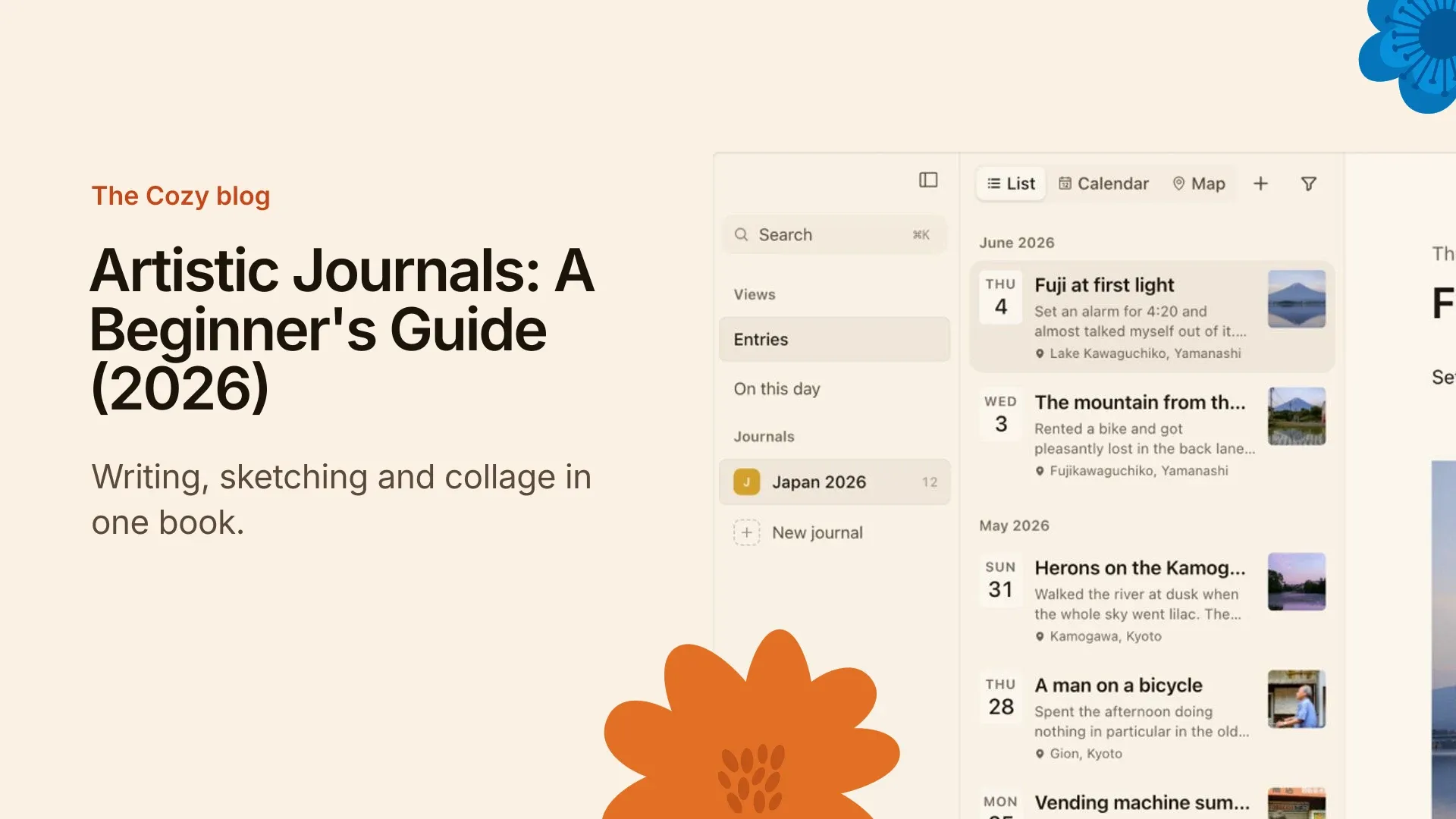
An artistic journal is a visual diary that mixes writing, sketching, painting and collage on the same page. It is less about making good art and more about trying things, catching ideas and keeping a record of how you saw a day. Nobody grades it, and it doesn’t have to look finished.
That’s the whole definition. The rest of this page is how to start one without buying the wrong book.
More than a sketchbook
A sketchbook usually holds drawings. A diary usually holds words. An artistic journal holds both, plus whatever else landed on the desk: a ticket stub, a scrap of newspaper, a swatch of the colour you mixed by accident.
The idea is old. People have kept commonplace books for centuries, pages of quotes, drawings and half-formed thoughts side by side, and Leonardo da Vinci’s notebooks are the famous case: diagrams, mirror writing, shopping lists and flying machines on one page.
The difference from a portfolio is that the pages aren’t for anyone. A portfolio is what you show. An artistic journal is where you work out what you would show.
Why keep one
- It lowers the stakes. A page in a journal can be bad. That’s permission to try a colour combination you’d never risk on a good sheet of paper.
- It slows you down. Drawing the cup on the table makes you look at the cup, which is a small version of paying attention.
- It remembers things words skip. The grey of a morning is easier to paint than to describe.
- It shows your own progress. Flip back six months and the lines are different. You won’t notice that day to day.
Choosing your first artistic journal
Pick the book for the way you’ll use it, not for the look of it. Three questions sort most of it out.
What will you put on the page? Pencil and pen work on nearly anything. Watercolour and wet ink need heavier paper that doesn’t buckle, usually sold as watercolour or mixed media paper. Collage needs pages that can take glue without going wavy.
How will you carry it? A small book goes in a bag and gets used on the train. A large one stays on the desk and gets used on Sundays. Small beats large for beginners, because a half-empty pocket book is easier to open than a big one you’re saving for something good.
Does it lie flat? Binding matters more than people expect. A book that snaps shut fights you on every page. Stitched or spiral bindings open flat; glued spines often don’t.
Paper weight is printed on the cover as gsm, grams per square metre. Higher means thicker. If you mix wet and dry media in one book, buy a mixed media pad or book rather than a plain drawing one. Brands such as Strathmore and Canson sell all three types, and any art shop will let you feel the paper first.
If the first book feels precious, you bought the wrong one. Get something cheap enough to ruin.
The tools, from pencil to pixel
Start with what you already own. A pencil, a black pen, and one colour medium (watercolour, markers or coloured pencils) is plenty for a month.
Then add as you notice gaps:
- Pencil and pen for quick studies and the writing side.
- Watercolour or ink wash for mood and background.
- Glue stick and scissors for collage.
- A white gel pen for lines on top of dark paint.
The part that isn’t paper
Most of what surrounds an artistic journal is words, and paper is awkward for some of them. Plans for the next spread, a list of what you used on which page, notes about why a piece failed, a folder of photos you want to paint from. These are the things a digital journal handles well.
You can keep a text journal next to the paper one: a sentence about what you made, what you’d change, and what you want to try tomorrow. A photo of the finished page sits beside the entry, so the paper book and the written record stay together.
I make Cozy for that kind of writing. It’s a journal app for Mac, Windows, iPhone and iPad, and it won’t draw or sketch for you; it’s the written half. Entries are your own files on your own disk, and nothing you write is read, trained on or sent anywhere. If you’re weighing apps for it, the best journaling apps compared is the place to start, and a journal with photos covers the picture side.
Common mistakes
Waiting for a good page. The first page of any new book is the hardest. Make an ugly one on purpose and the rest gets easier.
Skipping the writing. The pages you’ll value most later are the ones with a few lines about what was going on. Add a date and a sentence, always.
Not dating entries. Without dates you can’t see your progress. It takes three seconds.
Judging as you go. If you rip out pages, you lose the evidence of how you got better. Cross out, paint over or glue another page on top, but keep the book whole.
Buying supplies instead of making pages. More paint won’t fix a blank book. A pencil and ten minutes will.
FAQ
What are the best journals for artists?
It depends on your medium. Mixed media books handle the most, watercolour books take wet paint best, and a plain sketchbook is fine for pencil and pen. Check the paper weight, make sure the book opens flat, and buy the smallest size you’ll actually carry.
What is the dark side of journaling?
Mostly two things. Perfectionism turns a loose book into a chore, and privacy worries make people hold back. Both are fixable: allow ugly pages, and keep the book somewhere only you can open it, on paper or on your own device.
What are the 7 types of journals?
There’s no official list. Common types are the diary, gratitude journal, bullet journal, dream journal, travel journal, art journal and reflective journal. They overlap, and many people keep one book that does three of them.
What are the best journals for creatives?
The ones you’ll open. For visual work, that means paper that suits your tools, a size you carry, and a binding that lies flat. For writing and planning around the work, a digital journal in a place you trust is a good second book.
Can I use a digital app for my artistic journal?
Yes, for the written side. Use the app for plans, reflections and notes about your materials, and keep photos of finished pages next to the entries. The drawing itself can stay on paper or in a drawing app you already like.