Skip to content
Cozy logo

Changelog

Three ways to look back, and sync copies you can spot

New Features in 1.2.1

  • Look back through “On this day” as a list, a calendar or a map. The view now carries the same three tabs your entries do, so you can read past years straight down the page, spot them on a calendar, or see the places you were writing from.
  • Spot and clear sync-conflict copies. When two devices touch the same entry, Cozy keeps a spare copy so nothing is lost. That copy now wears a “Conflict copy” label in your list, and opening it offers to delete it. These copies stay out of “On this day” and the map, so a memory never shows up twice.
  • Start an entry while you’re looking at all your journals. The new entry button used to sit there grayed out in All journals. Now it asks which journal to put it in, or just writes there if you only keep one.

Improvements in 1.2.1

  • Names that stall a cloud sync get fixed. One file with a character Windows won’t accept can stop iCloud Drive syncing your whole folder on a PC, not just that file. Those names are perfectly legal on a Mac or an iPhone, so Cozy tidies them up when it opens a journal.
  • Cozy and iCloud take turns now. Cozy waits its turn before reading or writing a file iCloud is busy with, and won’t open an entry that hasn’t finished downloading. An entry still up in the cloud keeps the cover photo it had last time instead of showing up bare, and deleting one no longer pulls your whole journal down to check for shared photos.
  • Renames own up when they fail. Renaming a journal or a tracker used to report success either way. If part of your journal is still in the cloud, Cozy now holds off and tells you, rather than renaming half your entries and stranding the rest.
  • Your license can’t lock you out of your own writing. Saving in the first moments after launch is no longer refused as unlicensed, and one bad answer from the license server can’t deactivate you.
  • Imports are as hard to interrupt as saves. Bringing entries in from another app now survives a crash or a power cut the same way saving does, and the temporary files left behind get swept up.
  • Menus and popovers leave the way they arrived. Tag and tracker pickers, the heading menu, the writing-mode panels and the journal chooser used to blink out the instant you dismissed them. They ease away now.
  • A cleaner edge on your photos, and a few smaller touches. The hairline around thumbnails, photos in an entry and calendar days no longer picks up the warm tint of the page and reads like a smudge. Filter pills press in when you click them, the tick beside a tag fades into an × as you hover it, and text fields don’t flash a ring when you click into one.

Bug Fixes in 1.2.1

  • Editing an entry no longer duplicates it. Changing an entry’s location or date, or just switching away mid-sentence, could leave two or three copies in your list, sometimes with a “Sync conflict” note. Writing twice in one day also made the second entry rename its file on every save. Cozy keeps a single entry now, with one name.
  • Entries edited in another app keep their details. An entry opened somewhere else, with Windows-style line breaks or a hidden marker at the top, could come back with its title showing as ”---” and its tags, place, and trackers gone. Cozy reads those files correctly now.
  • Dates land on the day you meant. An entry written late in the evening could be filed under tomorrow, and the calendar could lose track of today on the night the clocks change.
  • Nothing goes missing when you move or delete. Moving an entry to another journal can no longer leave a copy behind in both, and photos you remove go to the trash instead of vanishing for good.
  • Photos hold up in your list. Thumbnails no longer turn into broken squares while you type or another device syncs, animated GIFs arrive animated instead of flattened to one frame, and a photo that fails to resize falls back to the original rather than coming up blank.
  • Dots and accents in names behave. A journal folder with a dot in its name kept forgetting where you were, and entries with accented filenames could miss changes synced from another device.
  • Trackers can’t take a name Cozy already uses. Calling one “title” or “date” used to collide with the hidden details at the top of an entry.

One box that runs Cozy, and a slash menu while you write

New Features in 1.2.0

  • ⌘K does more than find entries. It runs things now: start a new entry, open today’s or a random one, switch journals, change views, import from another app, or format what you’re writing. Each row shows its shortcut, so you pick them up as you go. The separate Jump to date box is gone, ⌘J opens the same search, and it reads dates the way you write them, “3/14”, “March 14”, or just “2020”.
  • Type / while you’re writing. A small menu opens right at your cursor with headings, lists, checklists, quotes, links, and everything you can insert, so you never reach for the toolbar mid-sentence.
  • Photos and videos are a keystroke away. ⌘⇧I drops one into an entry from anywhere in the editor, and there’s an image button in the formatting bar next to audio. ⌘⇧T opens tags, ⌘⇧M logs a tracker.
  • Move your journal’s folder without starting over. Settings now shows where your journal lives and lets you point it at a new folder. If you’ve moved it, just choose the new spot instead of removing the journal and adding it back.
  • Ask for your location from the Add location menu. The menu now opens with “Use current location”, so if a place didn’t attach on its own you can just ask again. The list underneath stays short, your last three places, until you start typing.
  • Edit on two devices, keep both. Change the same entry in two places before sync catches up, and Cozy used to quietly keep whichever saved last. Now the other version is kept beside it as a conflict copy, with a small notice so you know it happened. Nothing gets thrown away.

Improvements in 1.2.0

  • The list keeps up with you. A new entry shows up the moment you make it, a deleted one stays gone instead of flashing back, and renaming or dragging a journal into a new spot lands right away rather than waiting on the folder.
  • Picking a tracker option got quicker. The picker now has a search box and arrow keys, so with a long list of moods you can type a couple of letters and hit return. Escape clears what you typed, Escape again closes it.
  • Every shortcut is listed in Settings. The Shortcuts tab used to show a handful. It now covers navigation, journals, inserting, formatting, tags, and trackers.
  • Cloud-only entries still show their place and preview. In a cloud-synced folder, entries that hadn’t been downloaded to this computer used to show up blank. They now carry their title, preview and map location from the last time they were read, without pulling the whole file down.
  • A cloud journal catches up the moment you come back. Edit on another device, and returning to Cozy refreshes your entries right away instead of making you wait. Cloud folders also check for changes more often.
  • Your journals keep the name you give them. Creating or renaming a journal now names its folder the way you typed it, “Daily Journal” with its capitals and spaces intact, instead of flattening it to “daily-journal”.
  • Right-click your “On this day” entries. They now open the same menu as everywhere else, so you can reveal, open, move, or delete a memory without leaving the view.
  • Saving is harder to interrupt. A crash, a force-quit, even a power cut mid-save can no longer leave an entry half-written or empty. The same goes for photos and settings, including journals that live in iCloud or Google Drive.

Bug Fixes in 1.2.0

  • ⌘1 sets a heading without switching journals. Pressing ⌘1 through ⌘6 while writing used to make the heading and jump you to another journal at the same time. In the editor they now only set the heading level.
  • The map shows everywhere you’ve written, and keeps up as you move it. It used to plot only the cluster around your current city and stay stuck there when you panned or zoomed out. Now every entry with a location appears, wherever it is in the world, and the pins re-cluster as you explore.
  • A new cover photo shows up right away. Changing or removing an entry’s cover image used to leave the old one, or a broken thumbnail, sitting in the list for a second or two. The thumbnail now updates the moment you save.
  • Your location attaches more reliably. Cozy used to give up after three seconds, often before your Mac had an answer, so no place was saved and nothing said why. It now waits long enough, and tells you when it really can’t find you.
  • A renamed cloud journal no longer looks empty. Renaming a journal that lives in iCloud could make its entries vanish from the list until the cloud caught up. Cozy now keeps them listed while the folder settles.
  • Search works while the map is full screen. It used to open behind the map, and Escape closed the map instead of the search. Now search sits on top, and Escape closes it first.

A warmer voice, and photos you can step right through

Improvements in 1.1.2

  • A warmer, more playful voice throughout. The quiet corners of Cozy used to just state the facts. Now an empty journal asks you to plant a thought, your calendar blooms as you write, a fresh note is tucked into today, and even the little loading lines have some character.
  • Messages that tell you what to do next. When something goes wrong, like a dropped connection or an import that stops short, Cozy now says what happened and how to try again instead of a bare “Network error.”
  • A steadier list while it loads. The placeholder rows that show before your entries appear now match the real ones, so the list settles into place instead of shuffling as they arrive.
  • Open one photo and step through them all. Double-click any photo to see it big, and the arrow keys now move through every photo in that entry, not just the gallery it happens to sit in.
  • Grouping photos doesn’t mind the gaps. Pulling two photos into a gallery now works even when there’s a blank line between them, tucking that space away instead of leaving the photos apart.
  • Cozy opens on your newest entry. Starting the app takes you to the top of your list instead of restoring whichever entry you last had open. Changing the sort order takes you to the top too.
  • Today is easy to find on the calendar. The current day wears a soft dotted outline now, so it never gets mixed up with the solid ring around whichever entry you have open.
  • A new entry is ready the instant you ask for one. The page appears with today’s date already in place, no brief flash of loading before you can write.
  • Deleting several entries is sturdier. One stubborn file no longer stops the rest: Cozy finishes the batch, then tells you which entries it couldn’t remove. And the Delete menu now acts on everything you’ve selected, not just the highlighted entry.

Bug Fixes in 1.1.2

  • Accented characters come through intact. Smart quotes and your text replacements used to jump in while your keyboard was still composing a character, so a long-press accent or an input method could get scrambled mid-keystroke. They now wait until the character lands.
  • Writing in a Google Drive journal no longer trips over files that aren’t downloaded yet. An online-only entry that Google Drive hadn’t pulled onto this computer could raise an error in the background as you wrote, and a save could catch on the same snag. Cozy now handles those quietly.

A filter menu that counts, and steadier saves

Improvements in 1.1.1

  • The filter menu counts things up for you. Open the funnel and every row shows a number: how many entries have a photo, a video, a sound, or a location, and how many tags, trackers, and years you have to choose from. Before, you had to open each list to find out.
  • Attaching a big video or sound file is quick again. Cozy copies the file straight into your journal instead of loading the whole thing into memory first. That shortcut had quietly stopped working, so every clip was taking the slow way around.
  • Faint text is easier to read. Placeholder text, the month headings in your list, and the location line under each entry were all a shade too light against the warm page. They’re darker now, enough to meet accessibility contrast without losing their quiet.

Bug Fixes in 1.1.1

  • A saved entry no longer sits under a “Couldn’t save” warning. If Cozy saved your entry but then couldn’t rename the file to match a new title, something a synced folder can cause, it put up a warning that never went away, no matter how many times it tried again. Your writing was on disk the whole time. The warning now appears only when a save really didn’t go through.
  • Entry rows keep their own height. A row in the sidebar, or in the list over the map and calendar, could borrow the height of whichever entry used to sit in that slot, leaving a gap or a squeeze after the list refreshed or you changed a filter.
  • Quitting mid-sentence can’t wipe an entry. If Cozy closed while you were still typing, it could save an empty entry over your writing, keeping the title, date, and location but losing every word. It now leaves the file alone when there’s nothing to save.
  • Photos show up in entries written on another computer. Cozy used to save each photo’s full path, so an entry from a different Mac, or from before you renamed your account, pointed at a folder that no longer existed, and the photo came up blank. It now looks for the photo in your journal’s own attachments folder.
  • An entry that finishes downloading stops looking empty. When a file arrived from Google Drive or iCloud, your list kept showing it as not on this device, with no title or preview, until you reopened the journal.
  • Changing a date can no longer touch the wrong entry. If you set a new date and switched away before the save finished, slow going on Google Drive or iCloud, the rest of that save could land on the entry you’d moved to, or rename a file you weren’t even editing. Cozy now checks you’re still in the same entry before it finishes, and tells you if the save didn’t go through.
  • Formatting shortcuts toggle off again. Select some text and press Cmd/Ctrl+B: Cozy would bold it but drop the selection, so a second press just added empty asterisks instead of un-bolding. Now the text stays selected, so the shortcut turns formatting on and off the way you’d expect. Same fix for italic, strikethrough, code, and highlight.
  • Settings reach your journal even when its folder has gone missing. If you’d renamed or deleted a journal’s folder, or it hadn’t synced down yet, changing your font or text size in Settings quietly did nothing to the window you were writing in.

A System theme, and imports that come through clean

New Features in 1.1.0

  • A System theme that follows your Mac or Windows. Pick “System” in Themes, or from the menu, and Cozy matches your device’s light or dark setting, flipping along with it the moment your OS does.

Improvements in 1.1.0

  • Editing your trackers is safer. A rename or delete that would rewrite your entries now asks first, and every delete leaves an Undo. Typing a name you already have gets a gentle note instead of quietly doing nothing.
  • Your quick-entry note is never lost. Whatever you’ve typed into the tray capture window survives closing it, clicking away, or even quitting Cozy. It’s cleared only once it’s safely saved.
  • Cozy is easier to read and to size to your comfort. The whole app, not just the writing area, now scales with your zoom and your device’s text size, and faint labels, hints, and links were nudged to colors that meet accessibility contrast. Dialogs keep keyboard focus where you’d expect, and the main parts of the app are labeled for screen readers.

Bug Fixes in 1.1.0

  • Undo can no longer reach into another entry. After switching entries, pressing undo or redo could pull the previous entry’s text into the one you were reading and quietly save it there. The undo history now clears on every switch, even between entries that happen to look identical.
  • Imports read your entries faithfully. Notes from Day One, Obsidian, Bear, and Windows sometimes carry different line endings or a hidden byte-order mark, and those used to show ”---” as the title, drop their tags, or get scrambled when you changed their date. They come through cleanly now. A Notion page that opens with a line like “Mood: good” keeps that line too, instead of mistaking it for a page setting.
  • One bad file no longer sinks a whole Day One import. Cozy skips the item it can’t read, imports everything else, and tells you what it missed, instead of stopping with “no entries.” Imported dates also land on the right calendar day whatever your timezone.
  • Cloud journals are safer to write. Entries on Google Drive or iCloud are now saved atomically, so a crash mid-save can’t leave a half-written file. A sync arriving back on your machine no longer overwrites what you’re typing, and a tray quick-capture won’t clobber a daily note that hasn’t finished downloading.
  • Deleting a photo from one entry keeps it in the others. Removing an image you’d also placed in another entry no longer deletes the shared file out from under it.
  • Photo galleries behave in the list again. Older entries no longer show raw :::gallery markup in the sidebar, and you can select or edit the line of text right below a gallery.
  • A flaky graphics driver can no longer take Cozy down with it. On some Windows machines a struggling GPU would keep restarting until the app gave up and closed itself mid-session. Now Cozy rides out those hiccups and keeps your writing open.

Cozy's own license service, and a map that respects dark mode

Improvements in 1.0.9

  • Cozy now runs its own license service. Your key moves over by itself the next time Cozy checks in, with nothing to re-enter and nothing to re-activate. If the move can’t go through, your license keeps working just as it did.
  • Clearer wording when a license key doesn’t take. Expired, refunded, already at its activation limit: Cozy tells you which, instead of one catch-all “that key didn’t work.”
  • Buttons feel like buttons again. Presses ease into place instead of snapping, and colors fade on hover. The map’s expand button now cross-fades between its two icons.
  • Small controls are easier to hit. The sidebar toggle, the Windows menu button, and the emoji slot on a tracker all take a full-size click now, without looking any bigger.

Bug Fixes in 1.0.9

  • The map follows dark mode. Its tiles stayed light while the rest of Cozy went dark. They dim now, whether you start in dark mode or switch to it while Cozy is open.
  • Toolbar buttons no longer steal each other’s clicks. Their invisible click areas overlapped, so aiming at the edge of one formatting button could trigger the one next to it.

Privacy controls, faster cloud journals, and a lighter app

New Features in 1.0.8

  • New privacy controls in Settings. Turn off anonymous crash reports or automatic update checks whenever you like. Both stay on by default, but now it’s your call.

Improvements in 1.0.8

  • Opening a journal on Google Drive, iCloud, or another cloud drive is now just as fast online as it is offline. Cozy used to quietly re-upload some bookkeeping on every launch and download each changed entry’s photos just to measure them. Both are gone.
  • A gentle nudge when part of your journal hasn’t finished downloading. The sidebar points you at your cloud provider’s “available offline” setting, so you know how to bring the rest of your entries along.
  • Cozy is lighter and quicker off the mark. The app now ships its code bundled up instead of as thousands of loose files: around 20 MB lighter on disk, and it starts in about half the time.
  • Faster startup and smoother typing in long entries. The offline place-lookup dataset loads only when it’s actually needed, and math, table, and image formatting now update just the part of the entry that changed instead of rescanning the whole thing on every keystroke.
  • Smoother sidebar and entry-rail resizing. Dragging no longer stutters, and typewriter and background-music sounds no longer pile up work the longer a session runs.
  • Panels and menus settle more gently. We retuned the animation curves so things that slide into place feel calm instead of abrupt.

Bug Fixes in 1.0.8

  • Changing an entry’s date now updates its title to match. An entry still titled by its day used to keep the old day frozen as its title after a move; now the title follows the date, unless you’ve given it a title of your own.
  • Entries that open with a photo gallery or a positioned image now show their text in the list, instead of a raw :::gallery fence or a stray layout tag.
  • Fixed a crash on journals synced through Google Drive File Stream, where making a thumbnail could crash Cozy if a photo was still downloading. Cozy now reads the whole file first.
  • Wrapping text around an image actually wraps now. A full-width image left no room beside it, so Cozy now shrinks it to make room — and fixes a related quirk on Windows.
  • Entries on Filen and similar virtual drives no longer show as “not downloaded.” These drives report every file as offline, even ones already on disk; Cozy now checks whether a drive’s numbers can be trusted first.
  • Cozy is more careful about not losing your work. A save now finishes safely before anything else touches that entry, quitting right after a save no longer cuts it short, and a failed background save is retried instead of vanishing.
  • RAW photos show a clear “preview unavailable” placeholder on Windows and Linux instead of a broken image icon, and converting very large HEIC or TIFF photos no longer crashes.
  • Journal folders no longer fail to create on Windows when named a reserved device name like CON or PRN, and renaming or moving a journal on Windows no longer breaks links to its photos and videos.
  • Cozy now picks up changes to journals stored on Google Drive, Dropbox, OneDrive, and similar cloud drives, even when they don’t notify the app directly.
  • Copying in an attachment with a different-case filename no longer overwrites the original, and some shadows, borders, and the checkbox checkmark now adapt to dark mode.
  • Imports are stricter about what they’ll touch. Day One, Bear, Notion, and Obsidian imports no longer trust attachment paths that could point outside your journal folder.

Windows fixes and a cleaner sidebar

Improvements in 1.0.7

  • The update notice is now a plain row above Settings instead of a coloured banner. It shows an icon, the label, and the version number. Clicking it still starts the download or restart.
  • Entries that haven’t synced from the cloud no longer show a badge icon in the list. The “not downloaded yet” message still appears when you open one.
  • Windows text is fixed throughout. “This Mac” is now “this device”, delete confirmations say “Recycle Bin”, and right-clicking media says “Show in folder” instead of “Reveal in Finder”.
  • Corner radii are tighter at every level. Toolbar buttons, heading picker rows, and editor context menu items now match their container’s curve.

Bug Fixes in 1.0.7

  • Windows users in cloud-synced journals can create notes again. A fix in 1.0.6 to prevent offline hangs was incorrectly treating brand-new notes as not downloaded on Windows. OneDrive, Google Drive, and Dropbox placeholders are still detected correctly.
  • Live updates now fire when entries change on disk. A file watcher bug meant external changes to entries never triggered a refresh. This also fixes a crash on Windows when a journal lives on a Google Drive File Stream mount.
  • “Toggle Full Screen” appeared twice in the View menu on macOS. Now there’s one.
  • Clicking “New entry” right as a trial expires no longer throws an error. It now opens license settings instead.

Journal color theming and zoom-aware map clusters

New Features in 1.0.6

  • The interface tints to match your journal. Links, bullets, checkboxes, calendar highlights, and the selection ring all take on the active journal’s color and shift when you switch journals. A new + swatch opens the system color picker so you can use any color you like, and a “Use this color for highlights” checkbox lets you keep a journal on the theme default if you’d rather not tint.
  • Map markers cluster when you zoom out and split when you zoom in. Nearby pins merge into a count badge at small scales and break apart into individual markers as you zoom in closer. Tapping a cluster opens a sheet with all the entries inside.

Improvements in 1.0.6

  • All overlays and pickers are now draggable sheets. The entry list, tag picker, tracker picker, and link editor all slide up from the bottom with a handle you can drag to dismiss, on desktop and mobile alike. They sit over the current view without covering the rest of the interface.

Bug Fixes in 1.0.6

  • Opening a journal stored in Google Drive no longer freezes Cozy when you’re offline. Cozy now detects cloud-only files before trying to read them, shows a small cloud icon on the entry, and opens a friendly “not downloaded yet” message if you click one instead of hanging.
  • Switching journals no longer flashes an entry from the previous one. The editor now waits for the new journal’s list before deciding what to show.
  • The map no longer overlaps the title bar on Windows when Cozy is in full-screen.
  • Typing a city name without accents now finds it. “cordoba” surfaces Córdoba — the search strips accents from both what you type and the city list.
  • The journal entry count now updates as you add or delete entries instead of staying at zero until relaunch.
  • The hairline under the title bar on Windows is drawn correctly and no longer hides behind the min/max/close buttons.

Lightbox, menu bar quick entry, and offline location lookup

New Features in 1.0.5

  • Double-click any image to open it full-screen. A lightbox overlays the window with the photo at full resolution. If the image is part of a gallery, use the left and right arrows — or the ← → keys — to step through the rest. A counter shows where you are. Press Escape or click outside to close.
  • Wrap text around images. Click an image and a small floating toolbar appears above it with five layout options: block-left, centered, block-right, wrap-left, wrap-right. The wrap modes float the image to one side so the paragraph beside it flows around it. Choosing a block mode puts the image back on its own line.
  • Location lookup works without internet. Cozy no longer contacts an external service to turn coordinates into a city name. On macOS it uses the system’s built-in geocoder — the same one Maps uses. On Windows and Linux, and as a fallback when offline, it queries a bundled city dataset. No API keys, no network requests, no waiting.
  • Give each tracker its own emoji. Open the Trackers panel, click the small slot next to a tracker’s name, and pick from your system emoji picker. It shows as a prefix on the tracker chip in the editor and in the entry list. Leave it blank and the tracker stays text, same as before.
  • Jot a quick note from the menu bar. A small flower icon lives in your menu bar (macOS) or system tray (Windows). Click it and a panel drops down: a text area, a journal picker showing each journal’s color and emoji, and a Save button. Hit ⌘↵ (Ctrl+↵ on Windows) and the note goes into today’s entry in whichever journal you picked. If today’s entry already exists the note gets appended; otherwise Cozy creates it.
  • A global shortcut opens the panel from anywhere. ⌘⇧C (Ctrl+Shift+C on Windows) toggles the quick-entry panel even when Cozy isn’t the frontmost app. You can change the shortcut or turn the feature off entirely in Settings → General → Quick entry.
  • Closing the window no longer quits Cozy on macOS. The Dock icon hides instead, so the menu bar icon stays put and quick entry still works. The Dock icon comes back when you open a window again.

Improvements in 1.0.5

  • Tags are easier to add. The tag picker now has a dedicated search box to find existing tags and a + button to create a new one — no more guessing whether to type or click. Tags with no entries are removed from the list automatically.
  • The map can fill the screen. A small expand button sits in the corner of the map panel. Click it and the map takes over the full window so you can see where everything is. Press Escape or click the button again to go back. Clicking a single-entry pin opens that entry and collapses the map. Tapping a cluster keeps the map open and slides up a list of nearby entries to pick from.
  • Photos fade in instead of snapping into place. Images in the editor ease in as they finish loading rather than popping into the layout.
  • Images have soft rounded corners. A 6 px radius on photos matches the rounded feel of the rest of the interface.
  • Gallery photos lift slightly on hover, hinting they’re interactive. Double-click to open them in the lightbox.
  • A lone photo in a gallery spans the full width, instead of sitting in a narrow half-column with empty space beside it.
  • Writing Mode and Sidebar are grouped together in the View menu.
  • The sidebar toggle button is in the right place on Windows, sitting in the title bar strip instead of floating over the search box.
  • Cozy opens on Windows even when the settings file is briefly locked by antivirus or OneDrive. It retries a few times and, if the file stays locked, runs from the last-known settings so the session still works.

Bug Fixes in 1.0.5

  • The navigation rail stays where you left it. Collapsing it and relaunching Cozy used to open it back up every time.
  • ⌘\ hides the navigation rail, not the entry list. It was toggling the wrong panel and could leave you with no way back to the list if you were already in writing mode.
  • A video that can’t load shows a play badge instead of a blank box. YouTube and Vimeo embeds now stay legible offline; the real player takes over the moment you’re back online.

Notion import, title-free entries, and macOS text shortcuts

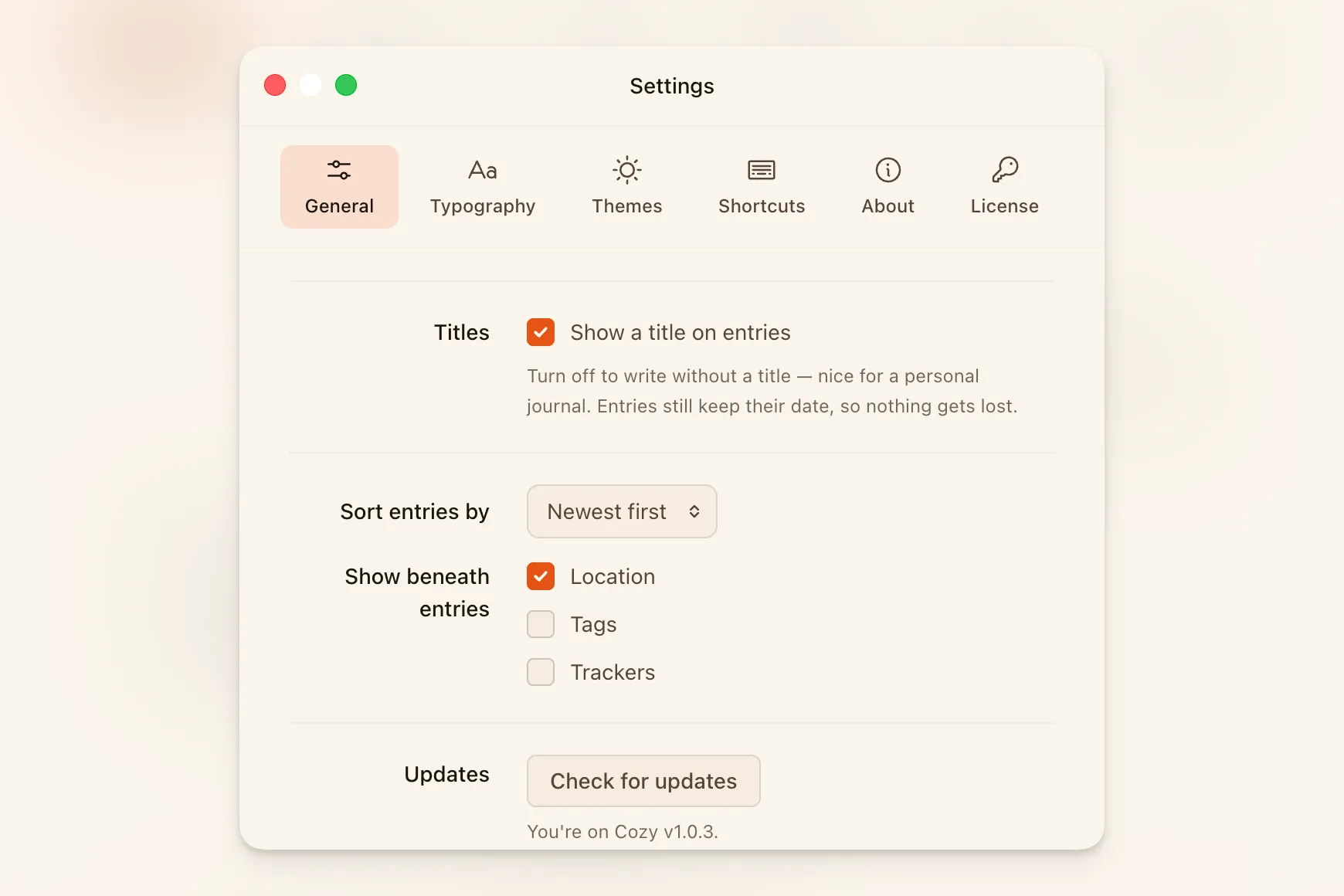
Cozy's settings for choosing what shows beneath each entry

New Features in 1.0.4

  • Import from Notion. Export your Notion workspace as Markdown & CSV, point Cozy at the folder, and your pages come in as journal entries — dates, titles, and tags along for the ride. Find it under File → Import, or on the opening screen when setting up a new journal.
  • Choose what shows beneath each entry. Settings now lets you pick whether an entry’s location, tags, trackers, or any mix of them appears below its title in the list. Location shows by default, as it always has; tags and trackers are there when you want them. Whatever you pick carries through the calendar, the map, and On This Day too.
  • Your macOS text shortcuts now work in Cozy. Whatever you’ve set up in System Settings → Keyboard → Text Replacements — “omw” for “On my way!”, abbreviations, longer phrases — Cozy now expands them as you type. They fire on a space or punctuation mark and skip code blocks, so your abbreviations stay put where you’re writing code.
  • Write without titles. There’s now an option in Settings to turn off the title line entirely. Entries just start — the date still shows in the toolbar, and your titles are kept quietly in each file, so turning it back on later doesn’t lose a thing.

Improvements in 1.0.4

  • The sidebar toggle button follows the rail. When the rail is open, the toggle sits at its right edge. Collapse the rail and it moves to the top-left corner beside the traffic lights — and disappears entirely in writing mode, where the rest of the chrome does too.
  • The rail remembers its state across journals. Collapsing the rail in one journal used to snap it back open the moment you switched to another. Now it works like the panel widths — whatever you set, it stays.
  • Cozy skips location detection when you’re offline. It used to spin for up to ten seconds trying to find your location with no connection. Now it bails immediately. On a slow connection, the whole lookup — position plus place name — has a three-second limit so the editor doesn’t wait on you.
  • Entry previews show two lines instead of one. The snippet beneath each entry’s title in the sidebar used to collapse into a single truncated line. It now shows up to two and preserves paragraph breaks, so a quick scan tells you more about what’s inside.

Bug Fixes in 1.0.4

  • Search previews show only your words. An entry with an image used to show its raw image markup — ![alt text](filename) — in the search result preview. The preview now shows only the text you wrote.
  • Tags and tracker values stick after you save on cloud drives. If your journal lived in a synced folder — Google Drive, Dropbox, iCloud, OneDrive — a tag or tracker you added could flash in the sidebar and then quietly revert until you restarted. The sidebar now refreshes from the saved file the moment the write completes.

All your journals in one view, journals you can color, and a faster start

Cozy's journal color and icon settings

New Features in 1.0.3

  • See every journal at once. When you keep more than one, a new “All journals” row sits at the top of the list. Pick it and Cozy pours all of them into a single feed, newest first, each entry wearing a little colored dot so you can tell where it came from. The calendar, the map, On This Day, search, and your filters all span the whole collection until you click back into a single journal. Open any entry and you stay in the feed, and it comes up with its own journal’s trackers and tags so editing across journals feels no different.
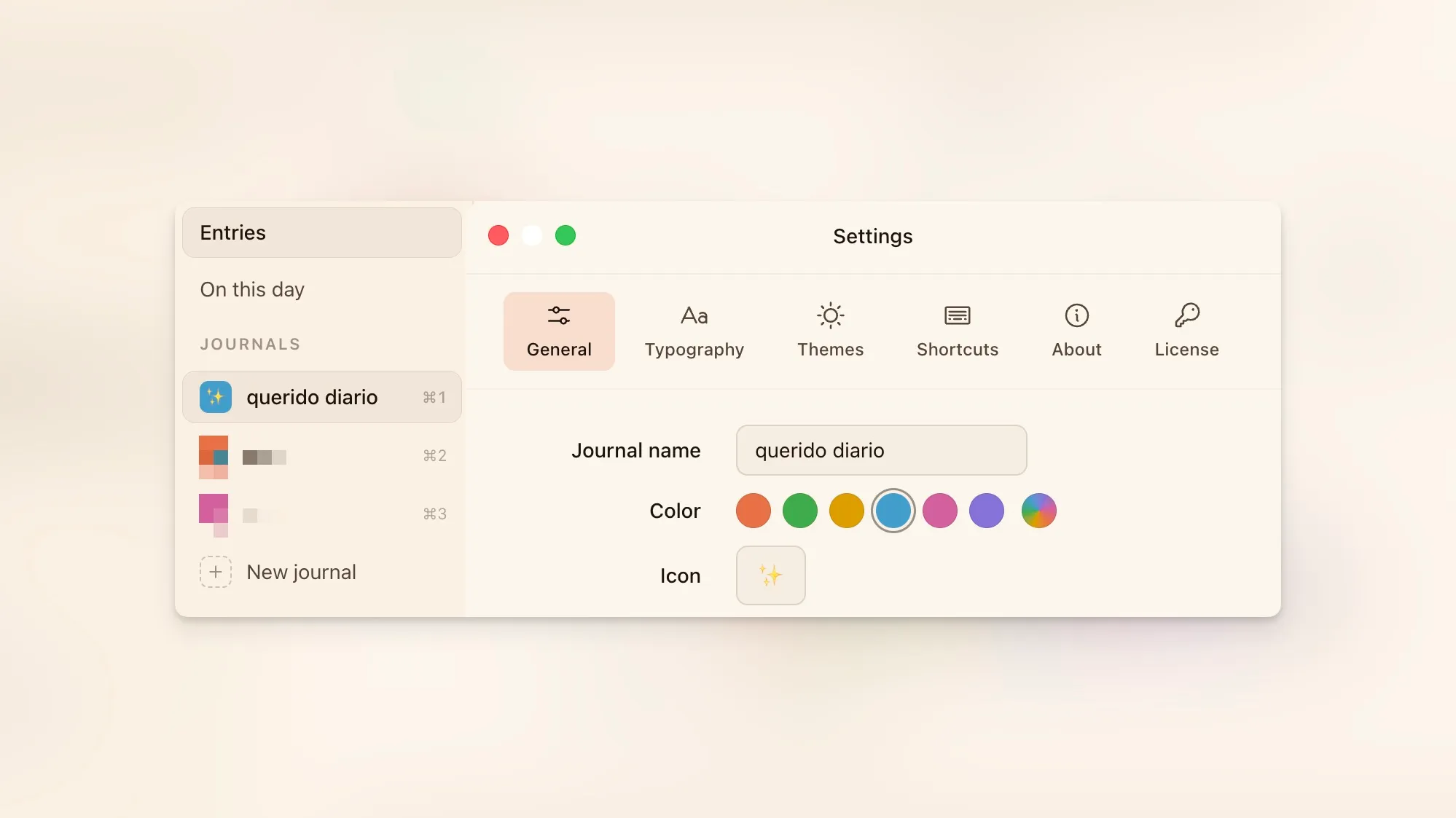
  • Give each journal its own color and icon. Right-click a journal in the sidebar and choose Edit, or open Settings, to pick a color from Cozy’s palette and an emoji of your own. The little badge beside each name wears them, so when you keep a few you can tell them apart at a glance instead of reading down the list. Leave the color on Auto and Cozy keeps choosing one for you, the way it always has.

Improvements in 1.0.3

  • Cozy opens right away. It used to sit on a blank window while it read through your whole journal before showing anything. Now the layout appears the moment you launch, sidebar and toolbar and writing space all there, and your entries fill in a breath later. The wait was longest on big journals, or ones kept in a synced folder like Google Drive, where it could stretch to a second or two. That’s gone.
  • Every journal shows how much you’ve written. The entry count now sits quietly at the end of each journal’s row in the sidebar. Hover over one of the first nine and its keyboard shortcut slides in over the number.
  • Cozy stops pestering you to reconnect. A valid license now keeps working for two months offline without a word, and only in the final week does a gentle, plain-spoken reminder appear, with a Try again button to re-check the moment you’re back online. Before, being offline a while, or a brief connection hiccup, could flash a stern warning and leave you re-entering your key.

Bug Fixes in 1.0.3

  • Windows chrome matches Cozy’s colors again. The title bar and window-control buttons were a slightly cooler, grayer shade than the warm cream filling the rest of the app, close enough to notice and off enough to feel wrong. They now use Cozy’s exact surface color, and when a panel like Trackers opens over a dimmed background, the min, max, and close buttons dim along with everything else.
  • iPhone photos and sidebar thumbnails hold up on Windows. The Windows build had been packaged with the Mac version of Cozy’s image engine, the part that reads HEIC photos and builds your thumbnails, so on Windows it had nothing to run. Windows now carries its own copy, so those pictures render and the thumbnails generate the way they should.
  • Search finds an entry by the name you see. An entry you never titled shows a friendly date in the list, like “Friday, June 5”, but searching that turned up nothing, because Cozy was quietly looking at the blank title underneath it. Search now reads the same titles you do, results and all, so typing what’s on screen finds it.
  • Search shows your words, not the file’s plumbing. A match used to spill the hidden header at the top of an entry into its preview line, and could even match on it. Cozy now searches and previews only what you actually wrote.

A Windows tune-up, spellcheck in your language, and a batch of fixes

  • The window can be moved again on Windows. Grabbing the title bar strip to drag Cozy somewhere else could simply do nothing. The strip is now wired up to be draggable no matter what, so the window goes where you put it.
  • The bottom bar no longer hides behind the Windows taskbar. If you’d maximized Cozy or used writing mode, the next launch could come back slightly too tall, with the word count, location, and tags strip half-swallowed by the taskbar. Cozy now remembers your real window size, including whether it was maximized, and always fits to the visible part of the screen.
  • Spellcheck now speaks your language. Cozy matches your computer’s language to the right dictionary even when the names don’t line up exactly: Portuguese lands on the Brazilian dictionary, Chilean Spanish on the Spanish one. Before, writing in Portuguese on a Brazilian-set computer got red-underlined as if it were misspelled English.
  • Deleting entries works on cloud and network drives. Some places a journal can live, like a Google Drive folder or a shared network folder, have no Recycle Bin, and deleting an entry there used to fail without a word. Now Cozy asks if you’d like to delete it permanently instead. And deleting an entry whose file is already gone no longer trips over itself.
  • Big photos stay put. A very large picture, like a full-resolution iPhone photo, used to flash into an entry and then vanish a few seconds later. Cozy was handing the whole giant image to the screen, which couldn’t hold onto it. Now Cozy sizes it down for display first, so it loads quickly and stays on the page.
  • No more orange rings around buttons and rows. Clicking or keyboard-hopping through the sidebar, settings, or calendar no longer draws a website-style outline around things, so Cozy behaves like the desktop app it is. Text fields keep their soft glow so you always know where you’re typing.
  • Quieter update checks. When GitHub momentarily can’t answer, usually a brief hiccup on their end, Cozy now treats it like any other passing blip. It still tells you and tries again later, but no longer files it as a crash report.
  • The menu no longer crashes after you close the window. On Mac, Cozy stays running in the menu bar once you close its window, and picking something like “Random Entry” from up there used to crash it. Now Cozy simply reopens your journal instead.

Day One imports that find your entries, and tidier journal removal

  • Day One imports work again for newer exports. Cozy used to look for a file named Journal.json, but recent Day One versions name it after the journal (like Gaming.json), so the import quietly brought in nothing. It now finds your entries whatever the file’s called, pulls in every journal when you’ve exported several at once, and lands each entry on the day you actually wrote it — no more entries slipping to the day before because of your time zone. Obsidian notes with their tags written as a list now keep those tags too.
  • Removing a journal works more reliably, especially on Windows. Cozy now closes the folder before moving it to the Trash, so the delete doesn’t get stuck the way it sometimes did. And if another program has the folder open and it can’t be trashed, Cozy tells you where it is and offers to open it — instead of saying it couldn’t remove the journal when it actually had.
  • The meadow now sits behind every empty view, not just a fresh journal. Whether you’ve just made a new journal or simply haven’t opened an entry yet, you get the same soft meadow at the bottom of the page.

Cozy leaves beta — rename your trackers, and video thumbnails that show

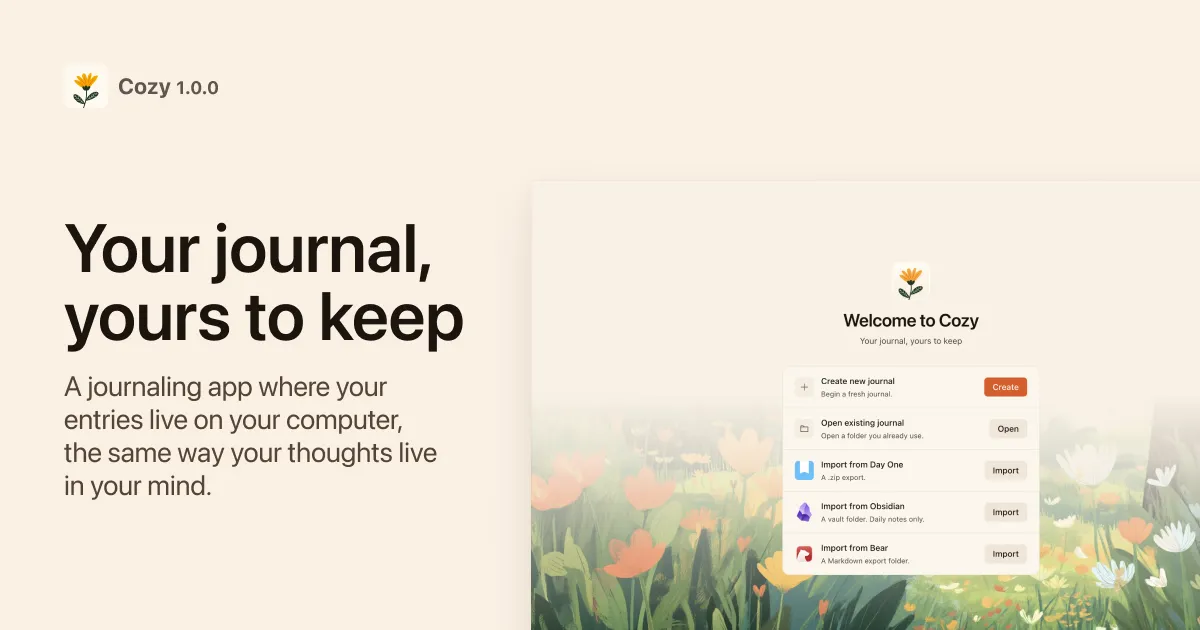
Cozy 1.0.0 welcome screen

  • Rename your trackers and their options whenever you like. Open Trackers, double-click a name (or use the little pencil) and type a new one. “Mood” becomes “Vibes,” “so-so” becomes “meh.” Cozy updates every entry you’d already filled in to match, so none get left on the old name.
  • Trackers now opens as a centered panel with a soft backdrop, instead of tucked against the toolbar. A little easier to land on.
  • Cozy now asks for your license key the first time you open it. Paste your key on the welcome screen to start writing — there’s a link to grab one if you need it, and another to recover a key you’ve misplaced. The free beta has wrapped up; thank you for writing with me through it.
  • Video entries now actually show their first frame in the sidebar. Instead of a blank tile, a clip’s thumbnail is its own opening frame with a play badge on top, captured right on your computer with no extra tools needed.

Filter by your trackers, smoother video, and a jump to the top

All platforms in 0.0.10

  • Filter your entries by what you track. The filter menu now has a Trackers section — pick one or more values from any tracker (Mood: Good, Weather: Sunny…) to narrow the list to just those days. Stack several values, or mix trackers with tags, places, and years, to land on exactly the entries you mean.
  • Find your way back to the top. When you scroll down your list — or open an old “On this day” memory that parks you deep in the past — a little pill slides up at the bottom; tap it to glide straight back to your newest entry.
  • Videos just play — and scrub. Clips you add, including iPhone .mov recordings, now start right away and seek smoothly when you drag the playhead, with nothing extra to install on your computer. Re-opening an entry with a video is instant too — it loads from cache instead of fetching and decoding the clip again.
  • Video entries look the part in the list. A clip now shows its first frame as the sidebar thumbnail with a little play badge, instead of a blank space — and the preview text no longer spills raw <video …> code.
  • iPhone photos show everywhere. HEIC pictures you drag in now render on Windows and Linux too, not just on Mac.
  • Day One import works on every platform. Bringing in a Day One export no longer needs any system tools, so it runs the same on Mac, Windows, and Linux — photos and videos included.
  • A quiet safety and privacy tune-up. Cozy is now pickier about which links and files it will open on your computer, and the crash reports it sends no longer carry your folder names or username — your journal stays yours.

Windows in 0.0.10

  • The title bar is now its own tidy strip. The menu button and the window controls share a dedicated band across the very top of the window, so they no longer crowd the search box, the toolbar, or the writing-mode button below them — and the menu is always right where you’d reach for it.

Move entries between journals, and a proper Windows menu

  • Move an entry to another journal. Right-click an entry (or a selection of them) and pick “Move to journal” — Cozy copies the writing and any photos, video, or audio it holds into the journal you choose and removes them from the old one. Pictures keep working at their new home.
  • New entries you don’t name are saved with a tidier filename. An untitled entry written today becomes 2026-06-04.md instead of repeating the date as a slug — the same daily-note convention Obsidian uses. Entries you do title are unchanged, and untitled Obsidian daily notes you import now show their date instead of a blank title.
  • Long entries breathe at the bottom. When you’re writing past the end of the screen, the last line now lifts toward the middle instead of clinging to the very bottom edge, so the line you’re typing stays in comfortable view.
  • The journal name in Settings now has a clear Save button that appears once you start editing, instead of a “Saved” flash after the fact. Press Esc to discard your edit and snap back to the saved name.
  • You can clear a location after adding one. Open an entry’s location chip and remove it, and the place is wiped from the entry — no more being stuck with a spot you picked by accident.

Windows in 0.0.9

  • The app menu is finally within reach. A menu button now sits in the top-left of the title bar — click it for New Entry, New Journal, Import, View options, and everything else that lives in the menu bar on Mac. No more hunting for the Alt key.
  • The writing-mode button no longer hides behind the window controls. It now tucks to the left of minimize/maximize/close so you can always reach the distraction-free view.

Easier writing mode, smarter formatting, and reliable cloud sync

  • Writing mode is easier to find. A small expand button now sits in the top-right corner of an entry, so you can slip into the distraction-free writing view with a click instead of hunting for the ⌘⇧F shortcut.
  • Formatting reveals itself more naturally as you write. Put the cursor anywhere inside a bold word, a link, or an image and its markdown shows up so you can edit it — not just when you land exactly on the symbols. Click anywhere on a heading and its # appears too, then tucks away the moment you move on. And you can skip typing symbols altogether: ⌘1–6 set heading levels, ⌘⇧8 makes a bullet list, ⌘⇧7 a numbered one. Checkboxes also work with * and + bullets now, not only -.
  • Keyboard shortcut hints now match your keyboard. On Windows and Linux they show Ctrl where macOS shows ⌘ — in Settings, tooltips, and the search bar — so the keys you read are the keys you press.
  • Journals kept in a cloud folder sync cleanly again. An open entry no longer sits “syncing” forever in Google Drive, iCloud, Dropbox, or OneDrive: Cozy now saves entries as a plain edit those tools recognize instead of a file-swap that left them spinning, and it won’t re-save an entry you’re only reading.

Free-drag image sizing, photo-wall galleries, and custom covers

Resize an image to any size you like: grab the little handle in its bottom-right corner and drag. The old 25% / 50% / 100% menu is gone — pick whatever width feels right, and Cozy remembers it in the entry.

Galleries now lay out like a proper photo wall. Instead of one cramped row, images flow into two balanced columns at their natural shape, so nothing gets cropped and tall and wide photos sit comfortably together.

Choose your cover: right-click any image in an entry with more than one photo and pick Use as Cover to set which one shows as the thumbnail in the sidebar. Leave it alone and Cozy keeps using the first image, like before.

Days and places with several entries open a tidy little sheet. Click a calendar day or a map pin that holds more than one entry and a panel slides up from the bottom listing them all — each with its thumbnail and a snippet — so you can pick the one you meant.

Fixed a rare way to lose writing: pressing Cmd+Z right after switching entries could undo into the previous entry and overwrite the one you were looking at. Undo now stops cleanly at each entry’s edge.

Entry previews in the sidebar used to show the messy leftover code behind a YouTube or media embed. Now they just show your words.

Opening “On this day” (or any entry with a very large photo) no longer freezes Cozy for a few seconds. Big images now resize without locking up the app, and they look sharp again — no more grainy previews.

Your journal no longer flashes empty at launch when a cloud-sync tool or macOS briefly locks the folder for a moment — Cozy now waits a beat and tries again instead of giving up on the first hiccup.

Faster startup and automatic update checks

Cozy now checks for new versions on its own while it’s open: every few hours, and whenever you click back into the window. A new release shows up in the sidebar without you opening Settings to hit Check for updates. Before, it only looked once, right after launch.

Cozy opens faster from a cold start. The editor and map now load only when you need them instead of up front, so there’s about a megabyte less to get through before your journal appears.

Sidebar thumbnails show up sooner on a fresh start. Cozy warms up previews for your newest entries first instead of decoding every image in the journal at once, so the list isn’t fighting itself for the first few seconds.

Trackers, image galleries, and smarter word count

Custom fields are now Trackers — same picker (Mood, Energy, Weather…), warmer name. Drag any tracker to reorder the list, and drag its options inside to set the order you’d rather see them in.

Saving entries and settings no longer crashes when the journal lives in a cloud-synced folder that briefly locks or hides a file mid-save (OneDrive on Windows, Dropbox/iCloud/Drive on macOS) — Cozy now writes straight to the file instead of giving up.

Image size: right-click an image and pick 25%, 50%, or 100%. Your choice is saved with the entry, so opening it later picks up right where you left off.

Image galleries: group photos into a single row instead of stacking them down the page. Right-click an image, pick Add to Gallery, and they line up next to each other. Each image keeps its own size — two at 50% sit side by side, four at 25% fit across.

Drag any image inside a gallery to reorder it, or drag one out to make it standalone again. Pull out the last image and the gallery quietly disappears.

Drag any image, video, or audio to a new spot in the entry to move it — no more copy-paste-delete shuffle.

Word count is honest about Chinese, Japanese, Korean, and other scripts that don’t put spaces between words: it counts actual words instead of treating each paragraph as one. The number you see when an entry opens also matches the count after your first keystroke (it used to flicker).

Editor polish, custom fields, and a friendlier map

Location autocomplete: start typing a city in the location field and Cozy suggests matches, so you stop guessing whether to write “NYC”, “New York” or “New York City”.

Custom fields got a friendlier face. Each picker now shows its name and value together (e.g. Mood: Good) with a small caret, sits on a subtle pill background, and has a thin divider separating it from tags, so it’s clear which chip is which. Tapping a field that has no options yet jumps straight into Manage Fields with that field already open.

New journals start with a ready-made Mood field (Great / Good / Meh / Low / Bad) so the feature is easy to find on day one. If you already had your own fields, nothing is touched.

When there are no fields yet, the + button now reads + Field so it’s obvious where to start.

“On this day” reads more clearly: the subtitle is now “What you wrote on May 18 in past years” instead of just the date.

Map: when several entries share the same spot, you can finally see all of them. The dot gets a little number badge (3, 12, 99+), and clicking it opens a short list of every entry pinned there. Tap one to jump into it.

Editor: bold actually looks bold now, and the raw **, *, ## , > , ~~, == stop hanging around after you use the toolbar or shortcuts. Blockquotes are a calm accent stripe instead of italic. Cmd+B (or I) on an empty spot puts the cursor inside the markers ready to type; press it again to step past them. Hit Enter inside **asas|** and you land on a new line below the bold, not between two stranded asterisks. Delete the word inside **word** and the leftover **** cleans itself up.

Text formatting and localization

Formatting toolbar now floats above selected text (Jira-style) — Bold/Italic/Strike/Code/Highlight/Link/Quote/Heading/Lists all accessible with one click. No more searching for the formatting menu. Markdown wrapping improved: selecting multiple paragraphs no longer leaves stray ** on separate lines, and selections adjacent to images won’t accidentally consume the image markdown.

Dates now consistently render in English everywhere—entry date buttons, InsertDate/Time menu, and Settings—regardless of your system language. This eliminates the issue where Spanish locale settings would display non-English month names in the UI.

Location editing now works by simply typing the city name where you wrote the entry. Your entries automatically capture and store location context.

Fixed a critical crash when deleting entries from the sidebar during rapid scrolling. Improved sidebar responsiveness and keyboard navigation for smoother multi-entry management.

Update notices, YouTube embeds, and Windows support

Fixed YouTube error 153 blocking video embeds. The player now correctly respects our cozy-app:// protocol, enabling seamless video integration directly in your entries.

Journals no longer go silently empty after filesystem hiccups. The entry list now recovers immediately on reopen instead of caching stale data—a critical fix for cloud-synced folders.

"Check for updates" fully restored. A packaging bug had prevented the updater from launching. Now includes immediate feedback, visible error messages, and offline error logs.

Settings no longer crashes when your journal lives in cloud-synced folders (iCloud, Dropbox) that briefly hide the config during saves—verified stable across sync scenarios.

YouTube embeds no longer autoplay from nearby clicks. The iframe loads YouTube’s native player controls, giving you full control over playback.

Empty journals now display a clickable "+ new entry" button for quick action. Calendar back-fill lets you add entries to any past or today empty day.

Sidebar update notices are quieter—appear only when necessary. Diagnostic logging for the updater and YouTube player is now visible offline in ~/Library/Logs/Cozy/main.log for faster debugging.

Windows

Native window chrome featuring a hidden title bar with theme-aware overlay, Mica background material, and hidden menu bar by default for a cleaner interface.

Drive-letter paths (C:\…) and youtube.com embeds are now handled correctly across media resolution and import workflows.

First beta release

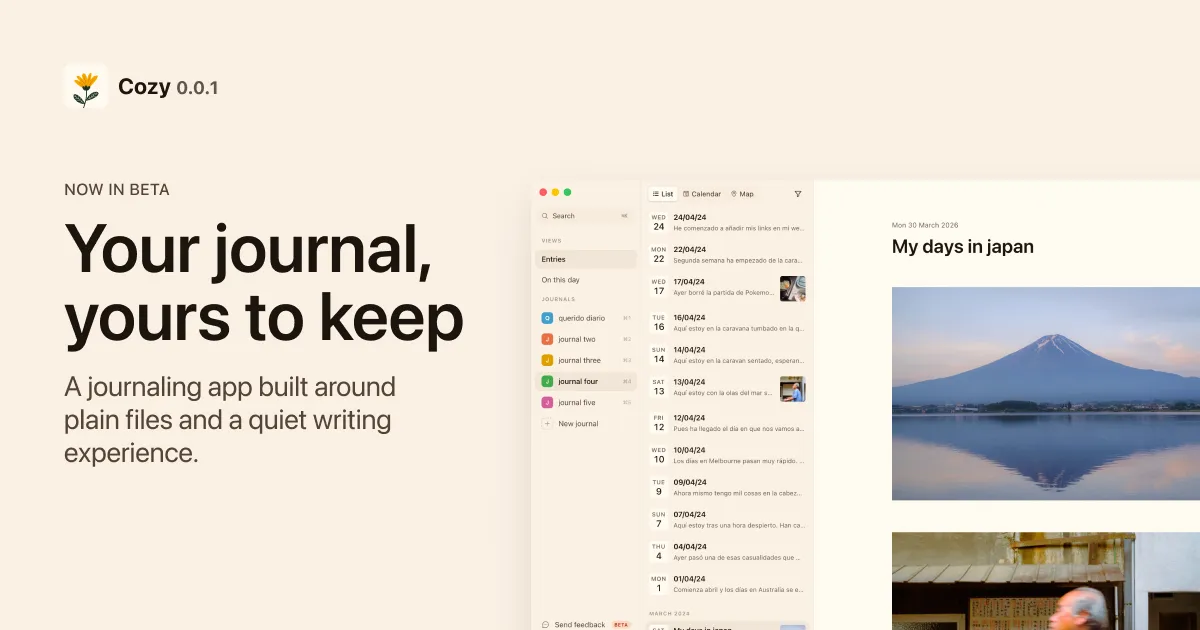
Cozy 0.0.1 beta interface

Welcome to Cozy, a private journaling app designed for Mac. Your entries are stored as plain text files on your machine—completely private with no cloud syncing unless you explicitly choose it. Your thoughts remain yours.

Write with comprehensive formatting: bold, italic, strikethrough, code, and links. Navigate your journal by date using an intuitive calendar view, or search across all past entries instantly. Your full writing history is always accessible and searchable.

Embed images and YouTube videos directly into entries for richer context and visual memory. Preserve moments alongside your words.

Light and dark modes automatically follow your system settings for comfortable reading at any time of day. This is an early beta release—we’re actively building and refining Cozy based on feedback.

Stay in the loop

Subscribe to get updates on new features and releases. I only send emails when there's something worth sharing, and you can unsubscribe anytime.