
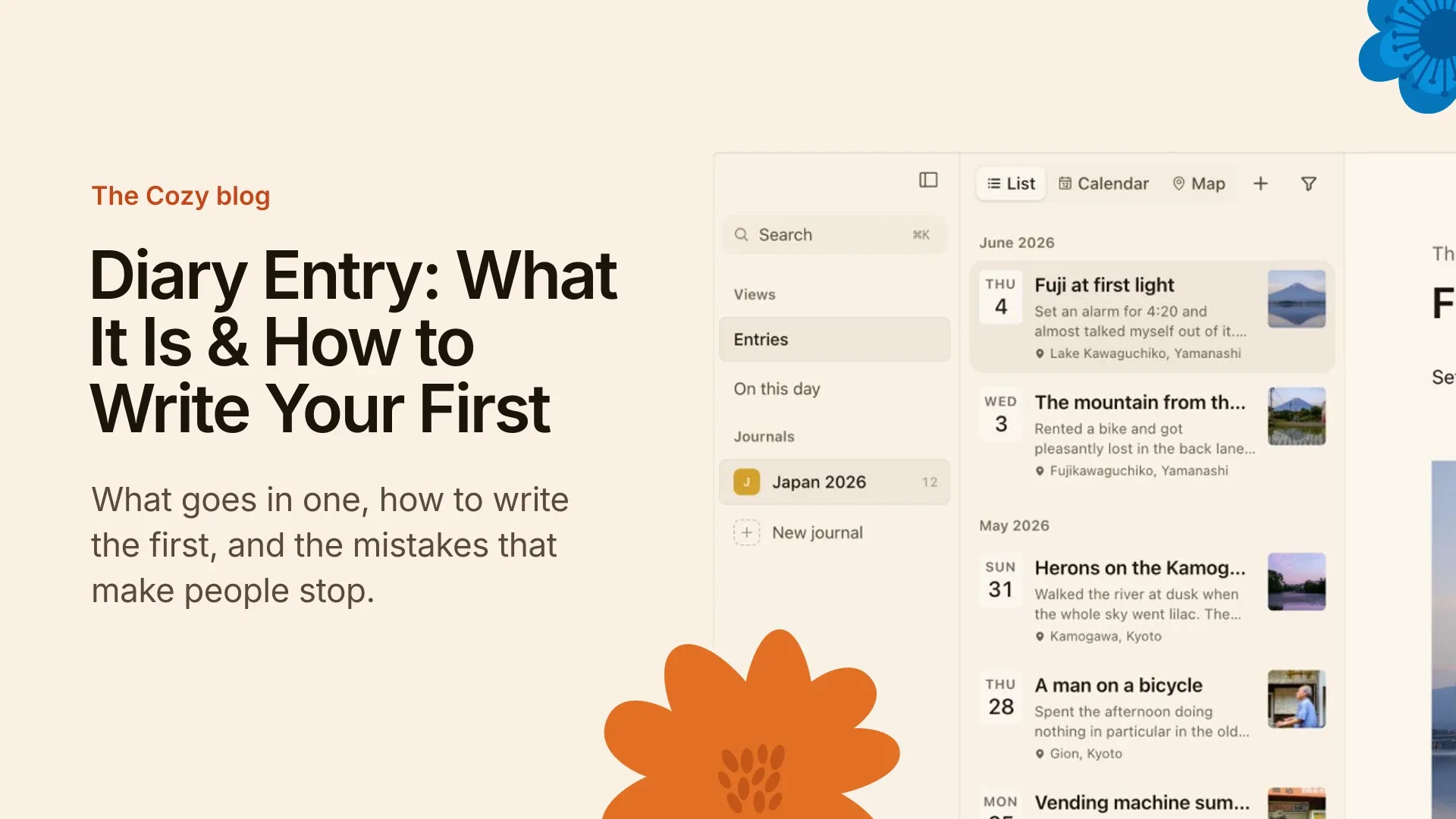
To write a diary entry, date the page, then write what happened and how you felt. There is no wrong way, and the only rule is that you show up. A diary entry is a short, private piece of writing about your day, dated and written in the first person: what happened, and how you felt about it. Nobody grades it and nobody reads it. Written often enough, diary entries clear your head at night and keep days you’d otherwise forget.
I’ve kept a diary since 2019. Most of my entries are short. This is how I’d explain it to someone starting tonight.
Why write diary entries?
Diary writing does two quiet things.
It empties your head. A worry written down is smaller than the same worry looping at 1 a.m. You put it on the page and the page holds it for you.
It keeps your days. You won’t remember a random Tuesday in March. Your diary entry will, along with what you ate, who you argued with and why it mattered then. I wrote more about the benefits of journaling, the slow ones that only show up after a few years, and about deeper self-reflection.
What to write in a diary entry
Anything true about today. If you’re stuck, pick one of these diary entry ideas:
- One thing that happened, described plainly.
- A conversation you keep replaying.
- Something you ate, saw or heard that you liked.
- How you feel right now, in one sentence, with no explanation.
- A small worry, and what you’d tell a friend who had it.
- What tomorrow looks like.
Still blank? I made a free journal prompt generator for exactly that moment. It gives you one question at a time. Click for another until one lands, then answer it as your entry. A gratefulness diary and gratitude journal prompts are two easy first entries, and journaling techniques has more.
Here’s a diary entry example, the kind I’d call a good one:
Tuesday. Rained all morning, so I worked from the kitchen. Called my sister, first time in two weeks. She sounded tired, and I didn’t ask why. I should have. Tomorrow I will.
A few lines. A date, what happened, a feeling, one thought for tomorrow. That’s a complete entry.
How to write your first entry: a simple process
1. Find your spot
Pick one place and one time. Bed before sleep, the kitchen table with coffee, a bench on your walk. The same spot does half the work: after a week, sitting there means writing.
2. Start small
One sentence is enough. “Today was long and I’m glad it’s over” counts. A bad first entry still counts. You can write more once the habit holds.
3. Write for yourself
No audience, no polish, no spelling worries. Write the way you’d talk to yourself on a walk. The moment you imagine someone reading it, you start performing, and the entry stops being useful.
4. Decide on a routine
Every night, or three times a week, or Sundays only. Any rhythm works if it’s yours and you can keep it on a bad week. Most of how to write a diary entry is showing up at the same time with low expectations.
If you want the longer version, with what to do in week three when most diaries die, read how to start journaling.
Common diary writing mistakes (and how to avoid them)
- Writing a novel on day one. A two-page first entry feels great and makes day two feel heavy. Stop while you still have something to say.
- Catching up on missed days. Skipped Wednesday? Write about Thursday. A diary isn’t a ledger you owe.
- Rereading too soon. Read last week’s entries and you’ll cringe. Read last year’s and you’ll be moved. Wait at least a month.
- Keeping it where others can read it. If part of you wonders who might see it, you’ll write less of the truth. Keep your personal diary somewhere that’s only yours. Some people choose a journal app without AI for that reason.
Questions people ask
What is a diary entry?
A diary entry is a dated piece of personal writing about your own day. It’s written in the first person, usually in the past tense, and it mixes what happened with how you felt about it. It can be one line or several pages, on paper or on a screen.
What are the 5 elements of a diary entry?
The diary entry format usually has five parts: the date, an optional opening (like “Dear Diary”), the first person (“I”), the events of the day told in order, and your feelings or thoughts about them. At school these are the rules. In your own diary, only the date really matters.
How do I start a diary entry?
Write the date, then the first true sentence that comes to mind: “Today I…” or “Right now I feel…”. Don’t plan it. The first line is the hardest, and after it the entry mostly writes itself. If nothing comes, describe where you’re sitting.
How often should I write a diary entry?
As often as you can keep up on a bad week. For most people that’s a few lines every night, or two or three times a week. Consistency matters more than length: one sentence a day for a year beats ten long entries in January.
What’s the difference between a diary and a journal?
A diary records your days: what happened, in order. A journal leans toward reflection: ideas, plans, prompts, feelings. In practice people use the words for the same thing, and most diaries become journals over time. Write whichever one you’ll open tomorrow.
Can a 12 year old have a diary?
Yes. A diary has no age limit. At 12 it is a good place to put feelings that are hard to say out loud. Keep it somewhere private, write a few lines when you feel like it, and know that nobody has to read it, not even a parent.
How do I write a diary entry for school?
Follow the school format: the date at the top, “Dear Diary” if your teacher asks for it, then the events of the day in order, written as “I”. Add one line about how you felt. A school entry is a short story about one day.
A place to keep it
Paper is a fine place for a diary, and I compared the screen options on the best diary app page. If you’d rather write on a screen, I built Cozy for exactly this: a private journal with a distraction-free page to write on. It runs on Mac, Windows, iPhone and iPad. There’s no AI in it, and every entry is one of your own files, on your own disk, that opens without Cozy. You buy it once, with no account. And if you’re switching from another app, your old entries come with you.