
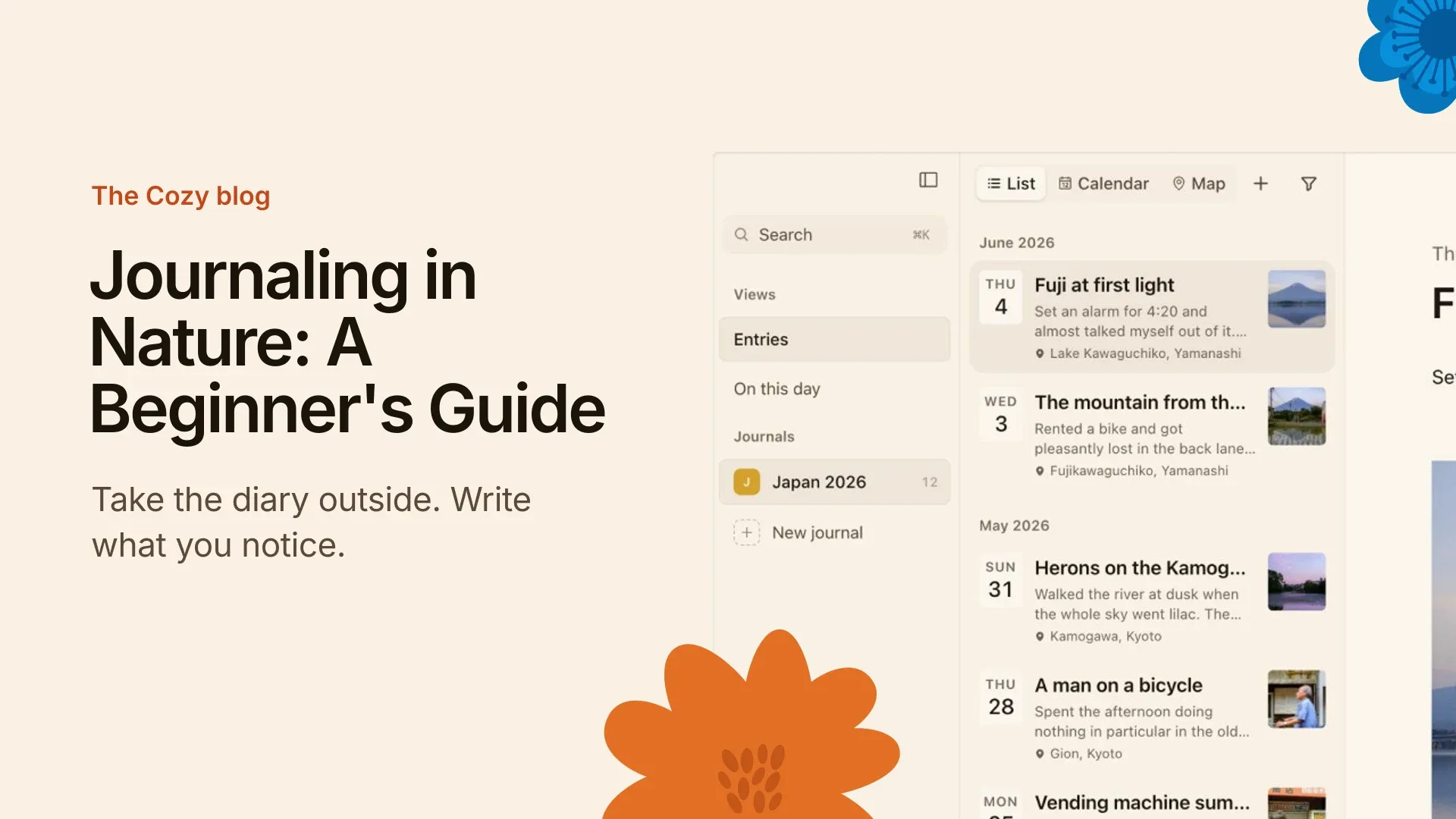
Journaling in nature means taking your diary outside and writing what you see, hear and feel there. You can sketch too, but you don’t have to. It’s less about good drawings and more about paying attention. A small notebook works. So does a journal app on your phone.
Why bother writing outdoors
Indoors, most of my writing is about my head: plans, worries, the day so far. Outside, there is something else to write about. A bird on a fence. The smell after rain. That gives you a way in when the blank page feels hard.
It also slows you down. To write down what a tree looks like, you have to look at the tree. That’s the whole trick.
You don’t need to be an artist, a naturalist or someone who hikes. A bench, a balcony or a patch of grass is enough.
How to start nature journaling for beginners
Keep the first try small. Ten minutes is plenty.
What to bring. A pen and a notebook, or your phone with a journal app. Nothing else is needed. A hat, if the sun is out.
Where to go. Somewhere you can sit still. A park bench, your garden, a window with a view of a tree. A place you can return to is better than a perfect one, because you start to notice what changes.
What to write. Pick one of these and start:
- Three things you see, three you hear, three you feel on your skin.
- The date, the weather and one sentence about your mood.
- One question you have about something in front of you (“Why do those birds all leave at once?”).
- A short note on how this place is different from last time.
Let go of getting it right. A messy line is fine. A list is fine. If you only write the weather, you still have an entry.
Digital or paper?
Paper is nice outside. It has no battery, no glare, and nobody gets a notification while you write. It can also get wet, and it’s easy to leave on a bench.
A phone is already in your pocket. You can write a few lines in a minute, add a photo of a leaf, and have it with you next to your other entries. The trade-off is the screen: bright sun makes it hard to read, and the phone can pull you into other things.
Some people carry both, a notebook for sketches and a phone for quick notes. I go with paper every time. Part of being out there is being present, and I already spend the whole day on a screen. So I sit down with a pen and a notebook, and later, at home, I type the pages into Cozy.
Keeping your outdoor notes private
Outdoor writing is often more personal than people expect. You sit somewhere quiet, and the things you wouldn’t say indoors start to come out.
If you write on a phone, it’s worth knowing where those words go. Many journal apps keep your entries on their servers. Some now add AI features that read what you wrote. That’s your call to make, but it should be a choice you made, not a default.
I make Cozy, a journal app for Mac, Windows, iPhone and iPad. Your entries are your own files on your own device. There is no AI in it, nothing you write is read or sent anywhere, and there’s no account or subscription. It’s a one-time purchase. If you want the details, there’s a page on private journaling apps, and one about why your files stay yours. If you’d rather write outside on your phone, the iPhone app is the one you’d take with you.
Cozy isn’t a nature journaling app. It won’t identify a plant or log a bird sighting. It’s a plain, private place to write, and that’s all this practice needs.
Common mistakes in nature journaling
Making it a project. If you buy supplies before you’ve tried it twice, you’ve made it a hobby with a shopping list. Start with what you have.
Drawing instead of looking. Sketching is great, but if you’re fixing a line for ten minutes you’ve stopped observing. Write the word “bark” and move on.
Waiting for a good day. Grey, windy days make better notes than you’d think. Write them too.
Never writing about yourself. Observations are the way in. Add one line about how you feel, or the entry is just a field guide.
Questions people ask
What is the 3-3-3 journaling method?
The name is used for several different routines, so check which one a source means. A version that works well outdoors is my own take: write 3 things you see, 3 you hear and 3 you feel. It takes about five minutes and needs no skill.
How do you do nature journaling?
Sit somewhere outside for ten minutes. Write the date and weather, then what you notice, then one line on how you feel. Add a sketch if you want one. Do it again next week in the same place and compare.
What is the dark side of journaling?
Writing can turn into going round in circles. If you write about the same worry again and again and feel worse, stop and change what you write. Describing what’s around you outdoors is a gentle way to break the loop. A journal is not a replacement for help when things are hard.
What is the 3-2-1 method for journaling?
Like the 3-3-3, this name covers a few versions. My outdoor take: 3 things you notice, 2 feelings, 1 question to carry home. It gives a short entry a shape, which helps on days when you don’t know where to start.
Do I need special supplies for nature journaling?
No. A pen and any notebook will do, or a journal app on your phone. A pencil is handy if you sketch, because it doesn’t run in the rain. Buy more only after you’ve done it a few times and know what you’re missing.
Your next step
Go outside tomorrow for ten minutes. Write the date, the weather and three things you see. That’s a nature journal entry, and it’s already more than most people write.
Alberto Gallego makes Cozy, a private journal for people who keep a diary. You can read more about me and Cozy.