
A daily reflection journal is a short look back at your day, written most nights. You note what happened, how you felt about it, and what you’d keep or change. It’s less a log of events than a record of your reactions. Over months, it shows you patterns you’d never spot from inside one day.
I’ve kept a journal since 2019, on and off but mostly on. I write at night, and most nights it’s 2 or 3 sentences about whatever the day left behind.
Why look back at all
The day moves fast enough that you rarely notice your own reactions while they’re happening. You’re annoyed in a meeting, relieved on the walk home, flat by dinner, and none of it gets examined. By morning, it’s gone.
A daily reflection journal puts a small gap between you and the day. A few minutes where nothing is asked of you except to notice. That’s most of what people mean when they connect journaling to mindfulness. You pay attention to the day after it’s over.
The value doesn’t come from one entry. One entry is a note. A few hundred of them, read back, are a map of how you react to your own life.
How to start: 3 daily reflection prompts
You don’t need a reflection journal template. You need a question small enough to answer when you’re tired.
The 3 questions
I write freely most nights, about whatever turned up. But on the nights nothing comes, a question gets the pen moving. These are the ones I’d hand to anyone starting:
- What happened today that I want to remember? One thing. A sentence someone said, the light at a certain hour, a meal.
- How did I feel, and when did it change? No mood score. Only where the day turned, if it did.
- What would I do again tomorrow, or differently? This is the reflection part. Keep it practical.
Most nights you’ll answer one of them. That counts. If you want a different question each time, the writing prompts tool picks one for you.
The question is only a way in. Start with something, even if it isn’t what you wanted to write about. A few lines later you’re usually writing about the thing that mattered, and writing more of it than you planned.
Same place, same time
Reflection sticks when it’s attached to something you already do. For me it’s at night, before bed. For other people it’s the train home, or the quiet after the kids are asleep. The time matters less than repeating it, because a habit you have to remember is a habit you’ll forget.
Keep it short
Give it a few minutes and stop. The nights I set out to write something good are the nights I write nothing. A short entry you write is worth more than a long one you skip.
“Tired. Work was fine. Rain again.” is a perfect daily reflection on a Tuesday that deserved nothing more. For longer samples, see examples of reflections.
What reflection has shown me since 2019
This past year I had a stomach problem that wouldn’t go away. I thought it had started a few months earlier. Then I searched my journal, and it was there much further back, mentioned in passing, in entries about other things. Small complaints I’d written down and forgotten, months apart, that turned out to be the same story.
That’s what writing to your future self is good for.
Another one I’ve written about before: I get restless roughly 6 weeks into anything that’s going well, and I always blame the project. I only saw it because I’d written the same paragraph, in slightly different words, 4 Januaries in a row. No single entry showed it. Reading them together did.
That’s the shape of every useful thing a daily reflection journal gives you: a worry that comes back every Sunday night, a person you always leave feeling smaller, a small win you’d forgotten by Friday. You can’t see any of them on the day. You see them when the same sentence turns up for the third time.
Common mistakes
- Writing too much. A reflection that takes 40 minutes is a chore by the second week. Cap it, and let the short entries count.
- Judging the entries. Nobody reads this. It’s a record, not literature. Bad sentences are fine. Missing ones are the only loss.
- Treating a missed day as a broken streak. I’ve missed weeks. The journal doesn’t know. Pick it up the next night and write about that night.
- Only writing on bad days. If you only reflect when something hurts, reading back gives you a distorted picture of your life. Write the quiet days too.
- Rereading every night. Reading back is the reward, not the practice. Once a year is plenty. I do it around New Year.
Paper or an app
Paper is lovely for this. It’s slow, it’s yours, and nobody can update it out from under you. The trade-off is reading back: a notebook is hard to search, and last year’s is hard to read next to this year’s.
An app makes reading back easy, and reading back is where daily reflection pays off. But a record of your reactions to your own life is about the most private thing you’ll write, so privacy and ownership matter more here than almost anywhere. Ask 2 questions of any app: who can read this, and will I still be able to open it in 20 years?
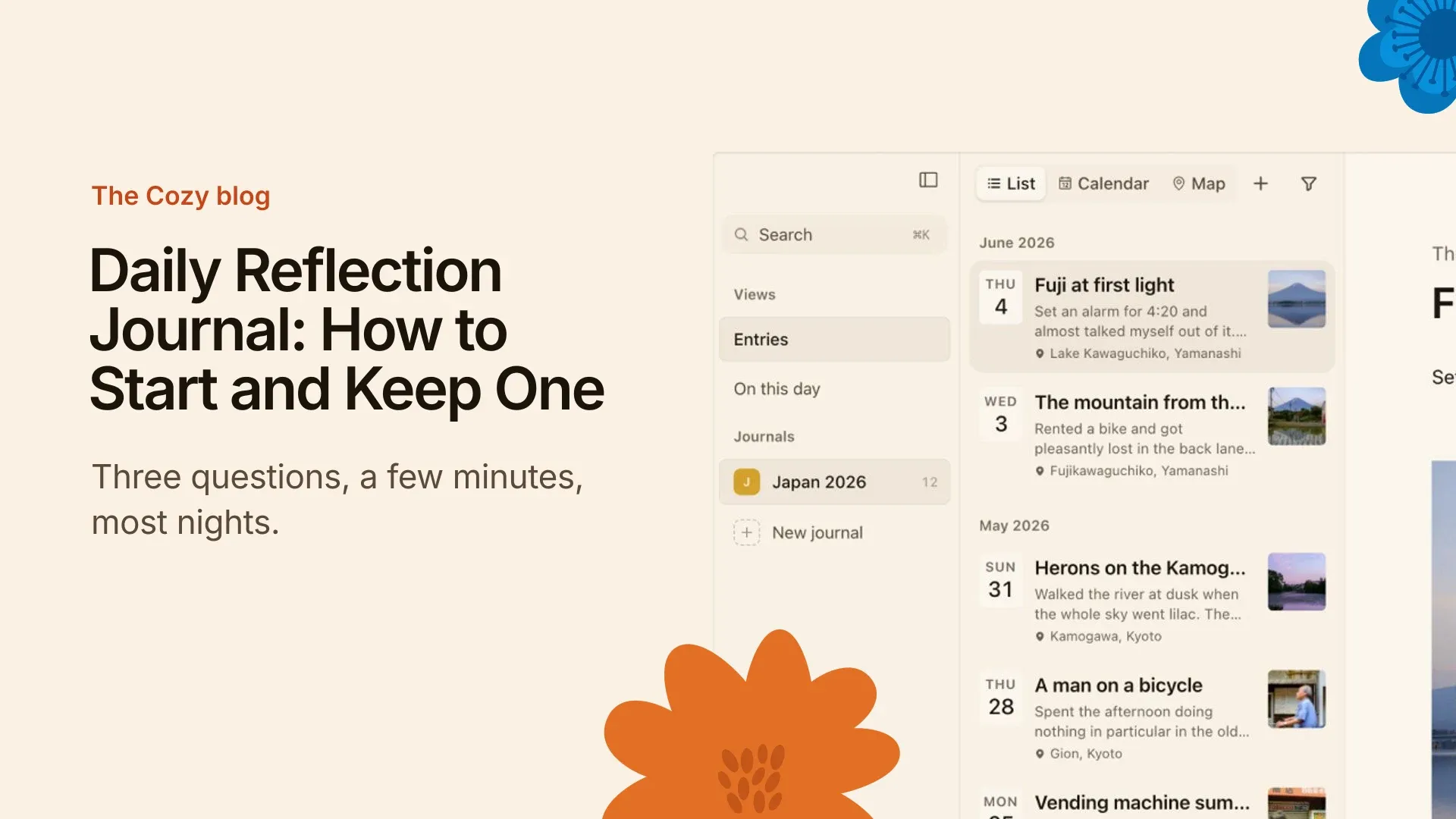
I built Cozy to answer both. It’s a local journal for Mac, Windows, iPhone and iPad. There’s no AI in it, nothing you write is read or sent anywhere, and your entries are your own files on your own disk, readable without the app. You buy it once. No account, no subscription.
Questions people ask
What’s the difference between a diary and a reflection journal?
Mostly the question you sit down with. “What did I do today” fills a diary, “how did today land” fills a reflection journal. In practice the two blur, and most of my entries do a bit of both.
What are good daily reflection journal prompts?
Keep them small enough to answer tired. What happened today that I want to remember? When did my mood change, and why? What would I repeat tomorrow? Rotate them, or answer only one. If you’d like a longer list, there are 100 journal prompts, grouped by mood, on this blog.
How long should a daily reflection take?
A few minutes is enough, and most nights I spend less. Short is what makes it last. Once reflection takes half an hour, you start skipping it, and a skipped entry teaches you nothing. Write 2 or 3 sentences, close the journal, go to bed.
Can I use a digital app for daily reflection?
Yes, and it makes reading back easier, which is where the patterns show up. Check 2 things first: whether anyone else can read what you write, and whether your entries live somewhere you control. I’d pick a local journaling app that keeps your writing on your own device, away from any server. If you want to compare options first, the best diary apps page puts 6 side by side.
What if I miss a day?
Write the next night as if nothing happened. There’s no streak to protect and nothing to catch up on. I’ve missed whole weeks and the journal never noticed. If something from the missed day still matters, it’ll come up on its own.
Tonight
If you’re looking for a place to start, here’s how to set up a first journal in Cozy. Or open any notebook you have nearby. Answer one of the 3 questions, then do it again tomorrow.
If you want to look at what your entries add up to, journaling for self-reflection shows how. Keeping a log of the day is close to a day book. For more ways to write, see journaling techniques and journaling for self-awareness.
If you want to log what you eat as part of the day, the best food journal app is a private one shows how to do it as a diary entry.