
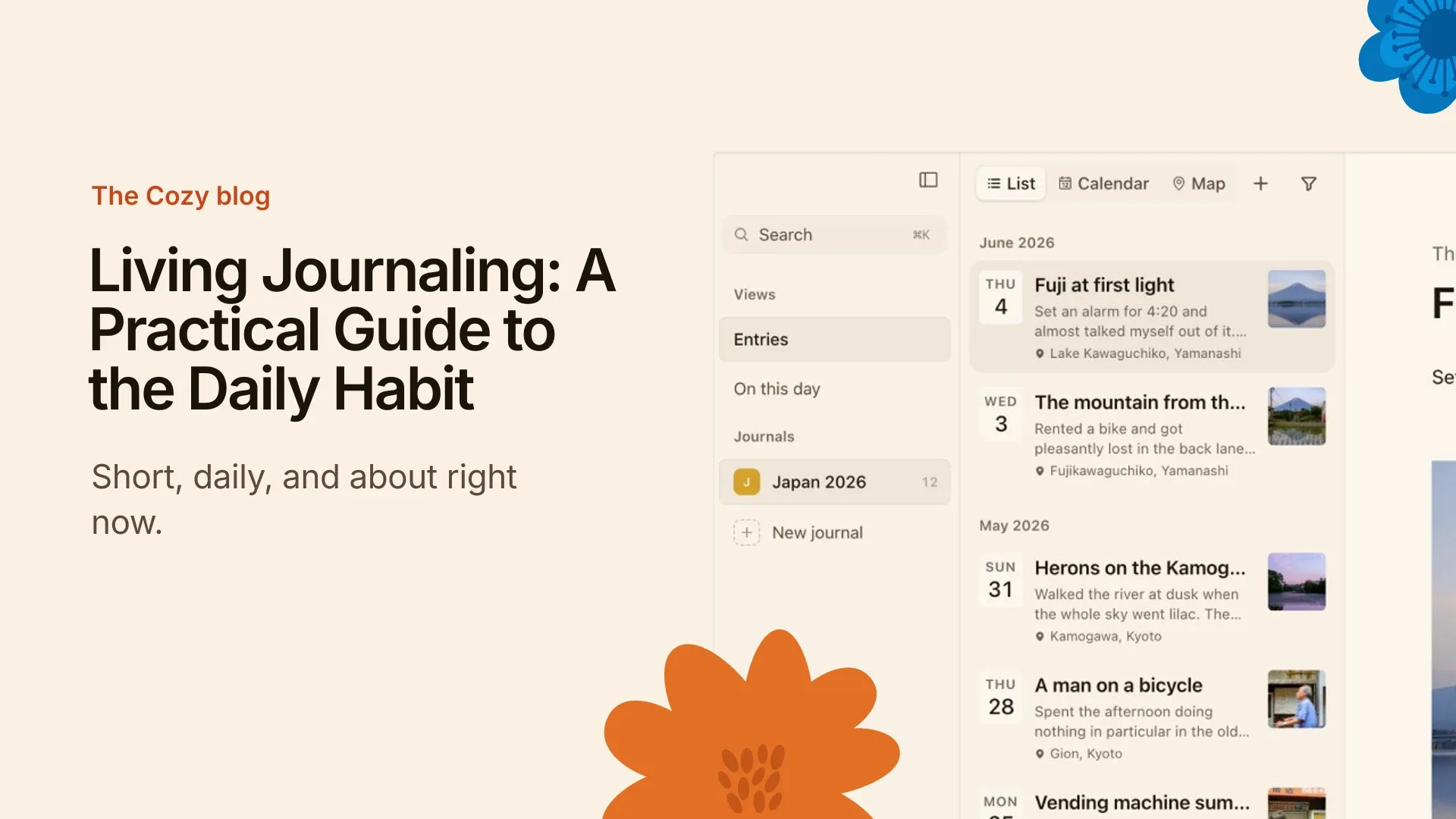
Living journaling means weaving short reflections into your day instead of saving up for a perfect entry. You write to get clear about what’s happening now, and the record is a side effect. A few lines count.
By Alberto Gallego, maker of Cozy. Updated October 8, 2026.
I’ve kept a journal for about 7 years. Not every day, not even every week. I don’t set rules for it: some days I write a long entry, other days one sentence is enough. I can’t force myself to write. It’s true that if I start and keep going for 10 minutes, I usually end up writing far more than I planned. But journaling has to be something that relaxes me, not another task to check off.
What living journaling is
Most advice about journaling pictures a long, quiet evening with a good pen and something important to say. That version exists, and it’s fine. It’s also the reason a lot of people write 3 entries and stop.
Living journaling sits at the other end. You write small, and you write while the day is still going. A line at lunch about the meeting that annoyed you. Two sentences on the train about the thing you keep not deciding. The entry doesn’t try to be a story. It’s thinking out loud, to yourself, with a record left over.
If you’ve come across mindfulness journaling, the two overlap. Both ask you to notice what’s here now. The difference is mostly size. Living journaling doesn’t need a quiet room or a ritual. It fits into the gaps.
It differs from the journaling you may have tried before in 3 ways. It’s low stakes: nobody reads it, and it doesn’t have to be good. It’s part of the day, so you write when something is on your mind, not only at a fixed hour. And it’s about processing. Looking back is a bonus. The value is in the writing itself.
How to start a living journal practice (your first week)
You don’t need a plan for the year. You need a week that goes well enough that you want an eighth day.
Ditch the rules before you begin
Rules are where the habit usually dies. Before day one, decide what you’re not going to do. You won’t write a minimum number of words or pages. You won’t fix spelling, tidy sentences, or reread yesterday. You won’t treat a missed day as a failure.
Most journaling mistakes come from making the habit bigger than the days it has to survive. I wrote about the first week in more detail in how to start journaling.
The 5-minute daily check-in
Pick one moment that’s already in your day: after coffee, when you sit down at your desk, when you get into bed. Then answer 3 prompts, in whatever order, in as few words as you like:
- What’s on my mind right now?
- What happened today that I’d hate to forget?
- What’s one thing I want to do differently, or keep doing, tomorrow?
If you only get to the first question, that counts. If you feel like writing for 20 minutes, nothing stops you. The 5 minutes are there to make it easy to begin, not to cap you.
Where to write: simplify your tools
The best journaling app is the one you’ll open without thinking about it. People still lose weeks to it. They test 6 apps, set up tags and folders, and never write the first entry.
A few questions help you choose:
- Is it fast to open? If it takes a login and a sync wait, you’ll skip it on a bad day.
- Can you trust it? A journal holds the things you tell nobody. If an app can read your entries, or may start to, ask whether you’d still write freely in it. I go into this in what makes a journaling app private.
- Will your entries outlive it? You want your writing to stay readable if the app disappears.
- Does it stay out of the way? Fewer buttons usually means more writing.
- Does it leave you alone? When I open my journal, I don’t want a banner pushing me to upgrade or pay more money.
Paper passes all of these if you’ll carry it. A notes app on your phone passes most of them. A dedicated journaling app earns its place if it makes the habit easier to keep. Choose one and stay with it for the first month.
Getting past day three
Day one is easy, because it’s new. Day three is where the enthusiasm wears off and the habit has to carry itself.
If 5 minutes feels like too much, write one sentence. A one-sentence day still counts. If you miss Tuesday, don’t write Tuesday on Wednesday. Write Wednesday. Keep the app one click away, which removes the small friction that makes people say “later”.
Day three entries are often dull. That’s normal, and the dull ones are still part of the record.
Good prompts for a living journal
“How was your day?” gets “fine”. Prompts that work for a living journal are present tense and specific, so you can answer them in a line:
- What am I avoiding right now?
- What did I notice today that I’d have missed last year?
- What’s taking up more room in my head than it deserves?
- Who did I think about today, and why?
- What would make tomorrow a good day, in one small way?
- What am I tired of pretending?
- What went better than I expected?
If you want more, 100 journal prompts grouped by mood has a long list, and the writing prompt generator picks one for you. If an entry starts somewhere else, follow it.
How living journaling supports your mental health
Writing things down gives them an edge. A worry that goes around in your head all afternoon becomes a few sentences on a page, and a few sentences are easier to look at than a loop.
It’s a way to process, not a treatment. It can help you notice patterns in your mood, name what you feel, and separate a problem you can act on from one you can only carry. It doesn’t replace professional help, and if you’re struggling, talking to a doctor or therapist is the right step. A journal can sit alongside that, as a place to put the week between appointments.
The living version has one advantage. Because you write close to the moment, you catch the feeling before memory rewrites it. I wrote more about the slower benefits in what I noticed after years of journaling, and about the heavier days in journaling for mental health.
Common mistakes
Running out of things to write is rarely why a journal stops. It’s usually one of these:
- Over-committing. “Three pages every morning” is a plan for your best self on your best day. Start with what your worst day can do.
- Judging your entries. If you edit as you go, you’re writing for an imagined reader. Write the clumsy version. Nobody is checking.
- Waiting for something to say. The days with nothing to say are often the days that most want writing down. “Nothing happened, and I’m oddly restless about it” is an entry.
- Using an app you can’t trust or can’t stand. If you hesitate before typing something private, or the app feels like a chore, you’ll drift away from it. Pick one you’re comfortable leaving your most private thoughts in.
Questions people ask
What are some good prompts for adults to write a journal?
Start with present-tense questions you can answer in a line: what’s on my mind, what am I avoiding, what went better than expected. Adults often write best when a prompt names a real, current situation rather than a vague theme. Keep 2 or 3 prompts you like and reuse them.
How is journaling good for mental health?
Writing turns a swirl of worry into a few sentences you can look at. That makes it easier to name a feeling, spot a pattern and decide what to do next. It works best next to other support when things are hard.
What are the most common journaling mistakes?
The big ones are setting the bar too high, judging your own entries, catching up on missed days and choosing an app that gets in the way. All 4 make the habit heavier than the days it needs to survive. Smaller goals, no rereading and one app you trust solve most of it.
How do I write a journal about my life?
Start with today, not your whole history. Write what happened, what you thought about it, and how it felt, in plain sentences. Over weeks, those small entries add up to a record of your life. If you want a guided start, how to write a diary entry walks through one.
Do I need a special app for living journaling?
No. Paper, a notes app and a dedicated journaling app can all work. What matters is that it opens fast, you trust it with private writing, and your entries stay readable if you ever switch. Pick one you’ll open on a tired day and stay with it for a month.
How is this different from morning pages or gratitude journaling?
Morning pages ask for 3 handwritten pages before anything else. Gratitude journaling asks you to list what you’re thankful for. Living journaling has no fixed form or time. It’s a few lines whenever something is on your mind. You can mix them. I wrote about why I don’t do morning pages if you want the contrast.
What if I miss a day, or a week?
Write the next day, not the missed one. Don’t apologize to the page or try to summarize the gap. One line about today is enough to start again. A journal with holes in it is still a journal.
A place for your living journal
Cozy is the journal I make. It runs on Mac, Windows, iPhone and iPad, and the entries are your own files on your own disk. Nothing you write is read, trained on or sent anywhere, and there’s no account to make. You buy it once, with no subscription. If a quiet, distraction-free place to write is what’s been missing, that’s what it’s for.
Want the same calm in the setting? Cozy journaling covers it.
New to the idea of keeping one? What it means to be a journal writer is the short answer. Whatever you use, begin with 5 minutes today. One line is enough. If you want an app that keeps those few lines private, the best diary app compared lists what to look for.
Alberto Gallego makes Cozy, a private journal for people who keep a diary. You can read more about me and Cozy.